

2026-08-03T06:46:03
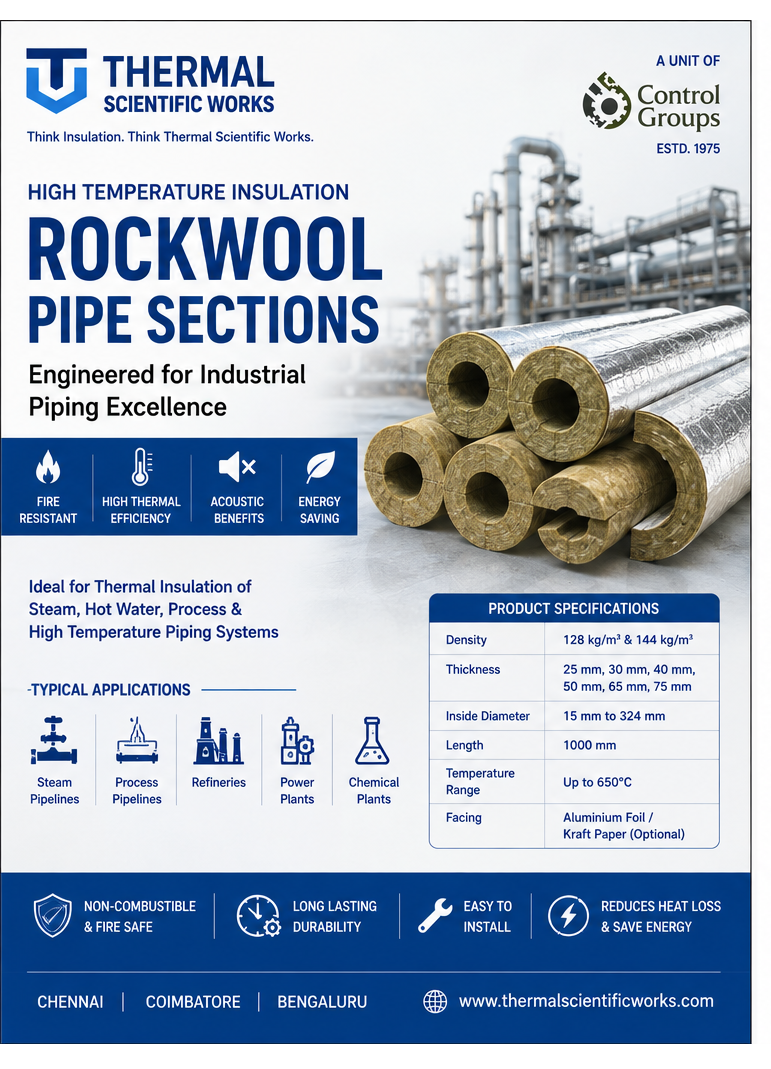
In industrial plants, pipelines carry valuable thermal energy from one process to another. Steam lines, hot-water systems and high-temperature process piping can continuously lose heat to the surrounding environment when they are inadequately insulated. This heat loss is not simply an energy issue. It can increase operating costs, affect process stability, create unnecessarily hot working environments and raise surface temperatures around personnel. Rockwool Pipe Sections provide an effective insulation solution for industrial piping systems where thermal performance, fire safety and long-term reliability are important. Thermal Scientific Works supplies Rockwool insulation solutions for demanding industrial applications, supported by technical knowledge developed from serving multiple industries. What Are Rockwool Pipe Sections? Rockwool Pipe Sections are preformed cylindrical insulation sections manufactured to fit around pipes. Unlike flat insulation materials that must be shaped extensively during installation, pipe sections are designed specifically for circular piping. This makes them particularly convenient for straight pipe runs and helps installers achieve consistent insulation coverage. Thermal Scientific Works' Rockwool Pipe Sections are available in densities including 128 kg/m³ and 144 kg/m³, allowing insulation to be selected according to application requirements. Why Insulate Hot Industrial Pipelines? An uninsulated hot pipe continuously transfers energy to its surroundings. The greater the difference between the operating temperature of the pipe and ambient conditions, the more important effective insulation becomes. Correctly designed pipe insulation reduces this unwanted heat transfer and helps preserve energy within the process. For plants operating large steam distribution networks or extensive process piping, reducing heat loss across hundreds or thousands of metres of pipeline can contribute meaningfully to overall energy efficiency. Better Process Efficiency Industrial processes frequently depend on maintaining temperature within specified operating ranges. Excessive heat loss between the boiler, process equipment and end-use point may reduce system efficiency and require additional energy input. Rockwool insulation provides resistance to heat flow around the pipeline, helping the system maintain operating conditions more effectively. This can be valuable in power plants, refineries, chemical facilities, manufacturing plants, boilers and industrial utility systems. Improving Workplace Safety Hot exposed pipelines can create hazardous surface temperatures. Insulating these surfaces helps reduce direct exposure to extreme temperatures and can contribute to safer working conditions around equipment. However, insulation thickness should always be engineered according to operating temperature, pipe diameter, ambient conditions, required surface temperature and applicable project specifications. Fire Performance for Industrial Environments Fire safety is another important consideration when selecting insulation for industrial facilities. Stone-wool-based insulation is inherently non-combustible, making Rockwool particularly attractive for applications where fire performance is an important design consideration. This combination of thermal insulation and fire performance makes Rockwool Pipe Sections suitable for many demanding industrial environments. Faster and More Consistent Installation The preformed geometry of pipe sections provides another practical advantage. Sections can be positioned around compatible pipe sizes and secured according to the specified insulation system. Where required, an appropriate external cladding system can then protect the insulation against mechanical damage and environmental exposure. Correct treatment of joints, bends, valves, flanges and penetrations remains essential. A high-performance insulation material cannot compensate for poor workmanship. Gaps, damaged insulation, badly finished joints or inadequate weather protection can create thermal bridges and reduce system performance. Protecting the Complete Insulation System Industrial insulation should be viewed as a complete system rather than simply an insulation material. The Rockwool provides thermal resistance, while suitable cladding and accessories help protect the installation. Depending on the operating environment, aluminium cladding, fastening systems and other accessories may form part of the finished assembly. Routine inspection is equally important. Damaged cladding or exposed insulation should be repaired before moisture or mechanical deterioration compromises the system. Insulation as an Energy-Saving Investment Industrial energy-efficiency projects often focus on major equipment such as boilers, compressors and motors.
Have a question? Ask here!
Required fields are marked *